
General Peptide Reconstitution Guide
A universal step-by-step guide to reconstituting any research peptide — covering workspace prep, bacteriostatic water, injection technique, concentration calculations, storage, and common mistakes to avoid.
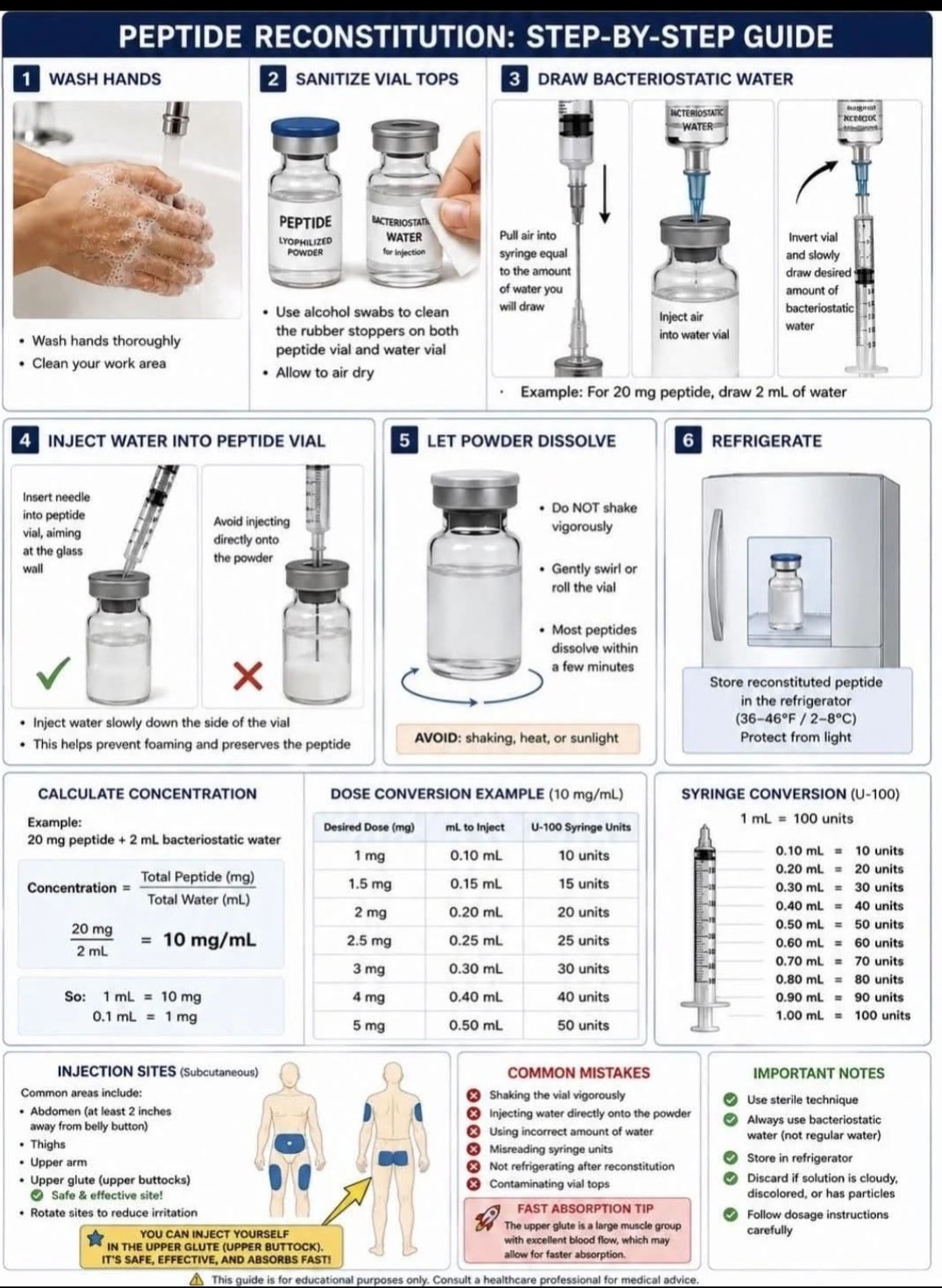
General Peptide Reconstitution Guide
Whether you're working with BPC-157, Retatrutide, CJC-1295, or any other lyophilized research peptide, the reconstitution process follows the same core principles. This guide covers everything you need to know — from workspace preparation through to storage and dosing calculations.
What You Need Before You Start
Gather the following before beginning:
- Lyophilized peptide vial (freeze-dried powder)
- Bacteriostatic water (BAC water) — 3mL or 10mL vial
- Insulin syringe (0.3mL, 0.5mL, or 1mL — 29–31 gauge recommended)
- Alcohol swabs
- A clean, sterile workspace
Always use bacteriostatic water — not sterile water, saline, or tap water. BAC water contains 0.9% benzyl alcohol, which prevents microbial growth and significantly extends the usable life of your reconstituted peptide.
Step 1: Wash Hands and Prepare Your Workspace
Wash your hands thoroughly with soap and water. Wipe down your work surface with an alcohol swab and allow it to air-dry before proceeding. A clean environment is the foundation of sterile technique.
Step 2: Sanitize Vial Tops
Using a fresh alcohol swab, clean the rubber stopper on both the peptide vial and the BAC water vial. Allow them to air-dry for 30 seconds — do not blow on them or wipe them dry.
Step 3: Draw Bacteriostatic Water
Pull air into your syringe equal to the volume of BAC water you intend to draw. Insert the needle into the BAC water vial, inject the air, then invert the vial and slowly draw the desired amount of bacteriostatic water.
Example: For a 20mg peptide vial, draw 2mL of bacteriostatic water.
Step 4: Inject Water Into the Peptide Vial
Insert the needle into the peptide vial and direct the stream of BAC water against the glass wall — not directly onto the powder. This prevents foaming and protects the peptide from degradation.
Inject slowly. Do not force the plunger.
Step 5: Let the Powder Dissolve
Once the BAC water is added, gently swirl or roll the vial until the powder is fully dissolved. The solution should become clear.
Do not shake the vial vigorously. Shaking introduces air bubbles and can degrade the peptide. Most peptides dissolve within a few minutes. Avoid heat or direct sunlight during this step.
Step 6: Refrigerate
Store the reconstituted peptide in the refrigerator immediately at 36–46°F (2–8°C). Protect from light by storing in the original vial or a dark container.
- Do not freeze reconstituted peptide
- Use within 4–6 weeks of reconstitution
- Lyophilized (unreconstituted) peptide can be stored at -20°C for much longer
Calculating Your Concentration
Use this formula to determine the concentration of your reconstituted solution:
Concentration = Total Peptide (mg) ÷ Total Water (mL)
| Peptide | BAC Water Added | Concentration |
|---|---|---|
| 20 mg | 2 mL | 10 mg/mL |
| 10 mg | 2 mL | 5 mg/mL |
| 5 mg | 1 mL | 5 mg/mL |
Example: 20mg peptide + 2mL BAC water = 10 mg/mL
- So: 1 mL = 10 mg, and 0.1 mL = 1 mg
Dose Conversion Reference (10 mg/mL)
| Desired Dose | mL to Inject | U-100 Syringe Units |
|---|---|---|
| 1 mg | 0.10 mL | 10 units |
| 1.5 mg | 0.15 mL | 15 units |
| 2 mg | 0.20 mL | 20 units |
| 2.5 mg | 0.25 mL | 25 units |
| 3 mg | 0.30 mL | 30 units |
| 4 mg | 0.40 mL | 40 units |
| 5 mg | 0.50 mL | 50 units |
Use the Peptide-Labs.ca Reconstitution Calculator to automate these calculations for any peptide and concentration.
Syringe Conversion (U-100)
On a U-100 insulin syringe, 1 mL = 100 units. Use this reference:
- 0.10 mL = 10 units
- 0.20 mL = 20 units
- 0.30 mL = 30 units
- 0.50 mL = 50 units
- 1.00 mL = 100 units
Subcutaneous Injection Sites
Common subcutaneous injection areas include:
- Abdomen — at least 2 inches away from the belly button
- Thighs
- Upper arm
- Upper glute (upper buttocks)
Rotate injection sites to reduce irritation. The upper glute is a large muscle group with excellent blood flow, which may allow for faster absorption.
Common Mistakes to Avoid
- Injecting BAC water directly onto the powder — always aim at the glass wall
- Shaking the vial vigorously — swirl gently instead
- Using incorrect amount of water — double-check your volume before injecting
- Misreading syringe units — confirm mL vs. units before drawing your dose
- Not refrigerating after reconstitution — reconstituted peptides must be kept cold
- Contaminating vial tops — always swab with alcohol before each use
Important Notes
- Always use sterile technique throughout the process
- Always use bacteriostatic water — not regular water
- Store in refrigerator after reconstitution
- Discard if solution is cloudy, discoloured, or has visible particles
- Follow dosage instructions carefully for your specific peptide
Source Your Peptides in Canada
Peptide-Labs.ca ships lyophilized research peptides and bacteriostatic water across Canada with discreet, cold-pack shipping. All products are third-party tested with published Certificates of Analysis — view the COA page for current batch results.
We stock BAC Water 3mL and BAC Water 10mL alongside our full peptide catalog.
Related Research Guides
- How to Reconstitute BPC-157 Specifically — peptide-specific ratios and dosing
- CJC-1295 + Ipamorelin Stack Guide — reconstituting a commonly used peptide pair
- Retatrutide Dosage Guide for Canadian Researchers — reconstitution for triple-agonist peptides
All products sold by Peptide-Labs.ca are intended exclusively for in vitro research and laboratory use. Not for human or veterinary use.
Explore Topics
Written by
Peptide-Labs Research Team
Content creator and writer sharing insights and stories.


