Peptide Storage Guide: Cold Chain, Reconstitution, and Shelf Life
Everything researchers need to know about storing research peptides correctly — lyophilized vs reconstituted storage, cold chain requirements, freeze-thaw cycles, and how to maximize peptide shelf life.

Peptide Storage Guide: Cold Chain, Reconstitution, and Shelf Life
Improper storage is the most common cause of peptide degradation in research settings — and the most preventable. A vial of 99%+ purity peptide can degrade to a fraction of its original activity within days if stored incorrectly. This guide covers everything Canadian researchers need to know about peptide storage, from the moment of delivery to the final dose of a reconstituted vial.
Lyophilized vs. Reconstituted: Two Different Storage Regimes
Research peptides are supplied in two states, each with distinct storage requirements:
Lyophilized (Freeze-Dried) Peptides
Lyophilization removes water from the peptide under vacuum, producing a dry powder that is dramatically more stable than the peptide in solution. Lyophilized peptides:
- Are stable for 24+ months when stored correctly
- Are less susceptible to oxidation, hydrolysis, and microbial contamination
- Can tolerate brief temperature excursions better than reconstituted peptides
- Should remain sealed until ready for use
Storage conditions for lyophilized peptides:
- Temperature: −20°C (standard freezer) is sufficient for most peptides; −80°C for maximum longevity
- Light: Protect from light — UV exposure degrades aromatic residues (Trp, Tyr, Phe)
- Moisture: Keep desiccated; moisture is the primary enemy of lyophilized peptides
- Seal: Keep vials sealed with the original rubber stopper until use
Reconstituted Peptides (In Solution)
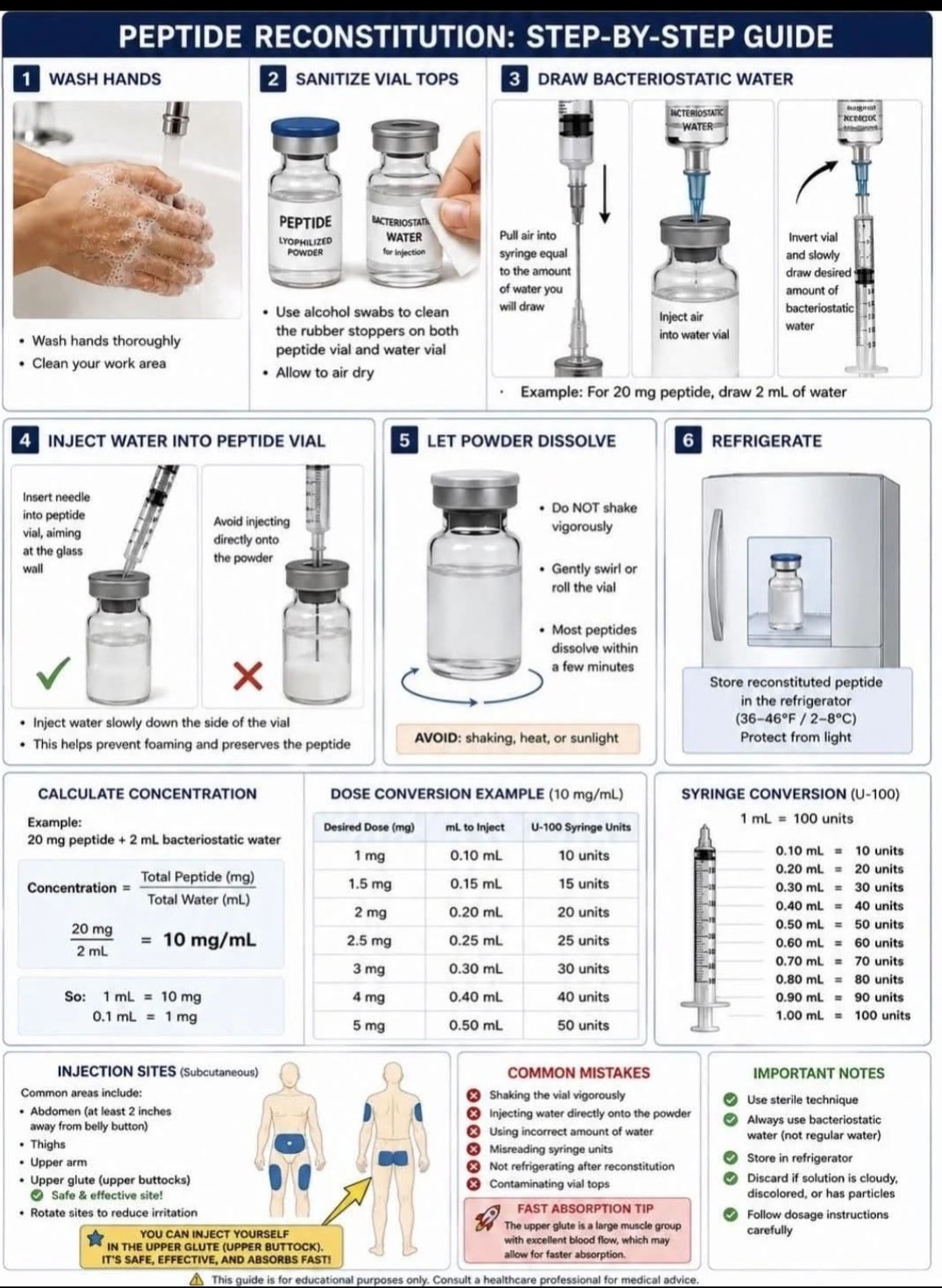
Once reconstituted with bacteriostatic water, peptides are significantly less stable:
- Susceptible to hydrolysis, oxidation, and microbial growth
- Shelf life typically 21–28 days at 2–8°C
- Some peptides (NAD+, tryptophan-containing peptides) degrade faster in solution
Storage conditions for reconstituted peptides:
- Temperature: 2–8°C (standard refrigerator)
- Light: Protect from light — wrap vials in foil if necessary
- Contamination: Use sterile technique for every withdrawal; never touch the rubber stopper
- Duration: Use within 28 days for most peptides; 7–14 days for NAD+ and light-sensitive compounds
The Cold Chain: From Synthesis to Your Lab
Cold chain integrity is critical for peptide quality. Every break in the cold chain — from manufacturer to distributor to your freezer — represents a potential degradation event.
What Is the Cold Chain?
The cold chain is the unbroken sequence of temperature-controlled storage and transport that maintains peptide integrity from synthesis to use:
Synthesis → Quality Testing → Cold Storage → Cold Shipping → Delivery → Your Freezer
Each step must maintain appropriate temperatures. A single warm transit can cause irreversible aggregation, oxidation, or hydrolysis.
How Peptide-Labs Maintains Cold Chain
At Peptide-Labs, all products are:
- Stored at −20°C from receipt through dispatch
- Shipped with ice packs or dry ice depending on transit time and season
- Packaged in insulated shipping containers rated for 48–72 hour temperature maintenance
- Accompanied by a Certificate of Analysis confirming purity at time of testing
What to Do When Your Order Arrives
- Inspect immediately: Check that ice packs are still cold or partially frozen
- Check vial integrity: Ensure seals are intact and powder is dry and free-flowing
- Transfer to freezer: Move lyophilized vials to −20°C within 30 minutes of receipt
- Do not reconstitute immediately: Allow vials to reach room temperature before opening to prevent moisture condensation
Bacteriostatic Water: Why It Matters
The choice of reconstitution solvent is as important as storage conditions. Always use bacteriostatic water (BAC water) for research peptides — not sterile water, not saline, not tap water.
What Is Bacteriostatic Water?
Bacteriostatic water is sterile water for injection containing 0.9% benzyl alcohol as a preservative. The benzyl alcohol inhibits bacterial growth, extending the usable life of reconstituted peptides from 24–48 hours (with sterile water) to 21–28 days.
Why Not Sterile Water?
Sterile water contains no preservative. Once the vial is punctured and the peptide is dissolved, bacterial contamination can occur with each subsequent withdrawal. Reconstituted peptides in sterile water should be used within 24–48 hours or discarded.
Why Not Saline?
Normal saline (0.9% NaCl) can be used for some peptides but is not recommended as a general reconstitution solvent. Salt ions can affect peptide solubility and stability, particularly for charged peptides. BAC water is the standard for research peptide reconstitution.
BAC Water at Peptide-Labs
Peptide-Labs supplies pharmaceutical-grade bacteriostatic water in both 3 mL and 10 mL vials — the same BAC water used in clinical settings.
Freeze-Thaw Cycles: The Hidden Degradation Risk
Repeated freeze-thaw cycles are one of the most damaging things you can do to a reconstituted peptide. Each cycle:
- Forms ice crystals that can physically damage peptide structure
- Concentrates solutes during freezing, potentially causing aggregation
- Introduces oxidative stress during the thaw phase
Best practice: Aliquot before freezing
If you need to store reconstituted peptide for more than a few days, aliquot the solution into single-use volumes before freezing:
- Reconstitute the full vial
- Divide into single-dose aliquots in sterile vials or insulin syringes
- Freeze aliquots at −20°C
- Thaw only what you need for each use
- Never refreeze a thawed aliquot
This approach limits each aliquot to a single freeze-thaw cycle.
Peptide-Specific Storage Considerations
Different peptides have different stability profiles. Here are key considerations for the compounds in the Peptide-Labs catalog:
Tryptophan-Containing Peptides (Selank, Semax, DSIP, Kisspeptin, PT-141)
Tryptophan is the most oxidation-sensitive amino acid. Peptides containing Trp:
- Are particularly susceptible to UV-induced degradation
- Should be wrapped in foil or stored in amber vials when reconstituted
- Have shorter reconstituted shelf lives (14–21 days recommended)
Disulfide-Containing Peptides
Peptides with disulfide bonds (cyclic peptides like PT-141) can undergo disulfide scrambling under oxidizing conditions. Store reconstituted solutions under inert gas (argon or nitrogen) if possible, or use within 14 days.
NAD+
NAD+ is significantly less stable in solution than most peptides:
- Reconstituted NAD+ should be used within 7 days
- Prepare fresh solutions for each research session when possible
- Store at 2–8°C in the dark; do not freeze reconstituted NAD+
BPC-157
BPC-157 is relatively stable but contains a methionine residue susceptible to oxidation:
- Reconstituted solutions stable for 28 days at 2–8°C
- Avoid exposure to air; use a nitrogen blanket if available
SS-31
SS-31 is one of the more stable research peptides due to its non-natural amino acid content (D-Arg, Dmt):
- Reconstituted solutions stable for 28 days at 2–8°C
- The Dmt residue provides some antioxidant protection
GHK-Cu
The copper complex in GHK-Cu requires special consideration:
- Reconstituted solutions can develop a blue-green colour (normal — this is the copper complex)
- Stable for 28 days at 2–8°C
- Avoid metal contamination; use plastic or glass syringes only
Storage Quick Reference
| Compound | Lyophilized | Reconstituted | Special Notes |
|---|---|---|---|
| BPC-157 | −20°C, 24+ months | 2–8°C, 28 days | Protect from air |
| CJC-1295 DAC | −20°C, 24+ months | 2–8°C, 28 days | — |
| Ipamorelin | −20°C, 24+ months | 2–8°C, 28 days | — |
| Retatrutide | −20°C, 24+ months | 2–8°C, 28 days | — |
| Tesamorelin | −20°C, 24+ months | 2–8°C, 28 days | — |
| GHK-Cu | −20°C, 24+ months | 2–8°C, 28 days | Blue colour normal |
| MOTS-C | −20°C, 24+ months | 2–8°C, 28 days | — |
| NAD+ | −20°C, 24+ months | 2–8°C, 7 days | Degrades rapidly in solution |
| SS-31 | −20°C, 24+ months | 2–8°C, 28 days | Stable due to D-amino acids |
| Selank | −20°C, 24+ months | 2–8°C, 21 days | Contains Trp — protect from light |
| Semax | −20°C, 24+ months | 2–8°C, 21 days | Contains Trp — protect from light |
| DSIP | −20°C, 24+ months | 2–8°C, 21 days | Contains Trp — protect from light |
| Kisspeptin | −20°C, 24+ months | 2–8°C, 21 days | Contains Trp — protect from light |
| PT-141 | −20°C, 24+ months | 2–8°C, 14 days | Cyclic; protect from oxidation |
| 5-Amino-1MQ | Room temp or −20°C | 2–8°C, 14 days | Small molecule; more stable |
| BAC Water | Room temperature | N/A | Use within 28 days of opening |
Signs of Peptide Degradation
How to identify a potentially degraded peptide:
Lyophilized:
- Clumping or caking (moisture exposure)
- Yellow or brown discolouration (oxidation)
- Unusual odour
Reconstituted:
- Cloudiness or precipitation (aggregation)
- Unusual colour change (beyond expected, e.g., GHK-Cu blue)
- Particulate matter
- Unusual odour
If any of these signs are present, do not use the peptide. Contact Peptide-Labs at [email protected] if you have concerns about product quality.
Related Guides
- General Peptide Reconstitution Guide
- How to Reconstitute BPC-157
- How to Buy Research Peptides in Canada
Research Use Only
All compounds referenced in this guide are intended solely for in vitro research and preclinical laboratory use. They are not approved for human consumption, veterinary use, or clinical application in Canada.
Explore Topics
Written by
Peptide-Labs Research Team
Content creator and writer sharing insights and stories.