SS-31 Peptide: Mitochondrial Research Guide for Canadian Labs
A comprehensive research reference for SS-31 (Szeto-Schiller peptide) — covering its cardiolipin-targeting mechanism, mitochondrial protective effects, oxidative stress reduction, and dosing for Canadian researchers.

SS-31 Peptide: Mitochondrial Research Guide for Canadian Labs
SS-31 (also known as Szeto-Schiller peptide 31, elamipretide, or MTP-131) is a mitochondria-targeted tetrapeptide with the sequence D-Arg-Dmt-Lys-Phe-NH₂. Developed by Dr. Hazel Szeto at Weill Cornell Medical College, SS-31 represents one of the most studied mitochondria-targeted compounds in preclinical research, with a unique mechanism of action centred on cardiolipin binding at the inner mitochondrial membrane.
What Is SS-31?
SS-31 is a cell-permeable, mitochondria-targeted tetrapeptide that selectively concentrates at the inner mitochondrial membrane (IMM) at concentrations several thousand-fold higher than in the cytoplasm. This selective accumulation is driven by electrostatic interactions with the negatively charged phospholipid cardiolipin, which is found almost exclusively on the IMM.
Molecular characteristics:
- Sequence: D-Arg-Dmt-Lys-Phe-NH₂ (Dmt = 2',6'-dimethyltyrosine)
- Molecular weight: 639.8 Da
- CAS number: 736992-21-5
- Also known as: Elamipretide, MTP-131, Bendavia
The dimethyltyrosine (Dmt) residue is critical — it provides antioxidant activity by scavenging reactive oxygen species (ROS) directly at the site of mitochondrial electron transport.
Mechanism of Action
Cardiolipin Binding
Cardiolipin is a unique phospholipid found almost exclusively on the IMM, where it plays a structural role in maintaining cristae architecture and supporting the electron transport chain (ETC) supercomplexes. SS-31 binds directly to cardiolipin, stabilizing its interaction with cytochrome c and preserving the structural integrity of ETC complexes I, III, and IV.
When cardiolipin is oxidized (a hallmark of mitochondrial dysfunction and aging), it loses its ability to anchor cytochrome c, leading to electron leak, ROS generation, and apoptotic signalling. SS-31 prevents cardiolipin oxidation and maintains cytochrome c in its electron-carrier role.
Reduction of Reactive Oxygen Species
By stabilizing the ETC and scavenging ROS via the Dmt residue, SS-31 dramatically reduces mitochondrial superoxide and hydrogen peroxide production. This is particularly relevant in models of ischemia-reperfusion injury, where ROS generation spikes upon reperfusion.
ATP Synthesis Restoration
SS-31 has been shown to restore ATP synthesis efficiency in models of mitochondrial dysfunction. By maintaining ETC complex organization and reducing proton leak, SS-31 improves the coupling efficiency of oxidative phosphorylation.
Mitochondrial Permeability Transition Pore (mPTP) Inhibition
The mitochondrial permeability transition pore (mPTP) opens under conditions of calcium overload and oxidative stress, leading to mitochondrial swelling, cytochrome c release, and cell death. SS-31 has been shown to attenuate mPTP opening in preclinical models, reducing apoptotic cell death following ischemic insult.
Cristae Remodelling
SS-31 has been shown to restore mitochondrial cristae morphology in aged and dysfunctional mitochondria. Cristae architecture is critical for ETC supercomplex assembly and ATP synthesis efficiency — its deterioration is a hallmark of mitochondrial aging.
Research Applications
Cardiac Ischemia-Reperfusion Injury
SS-31 has the most extensive preclinical literature in cardiac ischemia-reperfusion (I/R) models. Studies in rodent and large animal models have demonstrated:
- Reduction in infarct size (up to 40–60% in some models)
- Preservation of left ventricular function
- Reduction in cardiomyocyte apoptosis
- Improved mitochondrial morphology post-reperfusion
SS-31 (as elamipretide) has also entered human clinical trials for heart failure with preserved ejection fraction (HFpEF) and Barth syndrome.
Renal Ischemia and Fibrosis
Preclinical studies have examined SS-31 in models of acute kidney injury (AKI) and chronic kidney disease (CKD). Results include reduced tubular cell apoptosis, preserved mitochondrial function in proximal tubule cells, and attenuation of fibrotic remodelling.
Age-Related Mitochondrial Decline
SS-31 has been studied in aged rodent models as a potential intervention for age-related mitochondrial dysfunction. Research has demonstrated improvements in skeletal muscle mitochondrial function, exercise capacity, and cardiac performance in aged animals.
Neurodegenerative Disease Models
SS-31 has been investigated in models of Parkinson's disease (MPTP model), Alzheimer's disease (amyloid-β toxicity), and Huntington's disease, where mitochondrial dysfunction is a central pathological feature.
Skeletal Muscle Research
Studies in models of muscular dystrophy, disuse atrophy, and exercise-induced oxidative stress have examined SS-31's ability to preserve mitochondrial function and reduce oxidative damage in skeletal muscle.
SS-31 in the NAD+ / MOTS-C Protocol
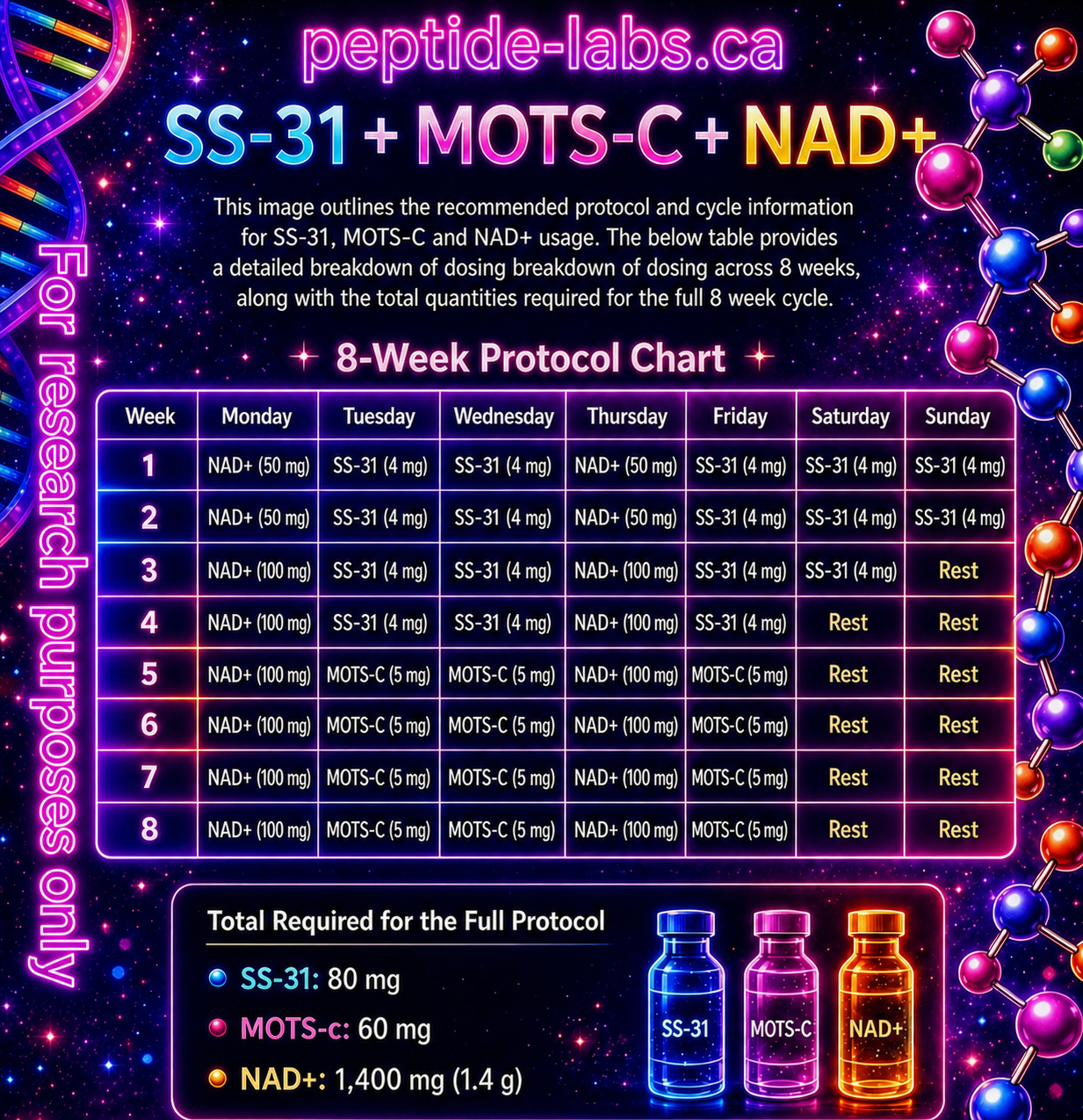
SS-31 is the Phase 1 compound in our SS-31 + MOTS-C + NAD+ 8-Week Research Protocol. The rationale for leading with SS-31 is to establish mitochondrial membrane integrity before introducing MOTS-C's metabolic signalling effects in Phase 2. See the full protocol for dosing schedule and total quantities.
Reconstitution
SS-31 is supplied as a lyophilized powder requiring reconstitution with bacteriostatic water (BAC water).
Suggested reconstitution:
- 10 mg vial + 1 mL BAC water → 10 mg/mL (10,000 mcg/mL)
- 10 mg vial + 2.5 mL BAC water → 4 mg/mL (4,000 mcg/mL)
- 50 mg vial + 5 mL BAC water → 10 mg/mL (10,000 mcg/mL)
Use our Reconstitution Calculator for precise volume calculations.
Dosing Reference (Preclinical Models)
| Model | Dose Range | Route | Frequency |
|---|---|---|---|
| Cardiac I/R injury | 1–5 mg/kg | IV / SC | Single dose or twice daily |
| Renal I/R / AKI | 2–5 mg/kg | SC | Once daily |
| Age-related decline | 3–5 mg/kg | SC | Once daily |
| Neurodegenerative models | 2–5 mg/kg | SC | Once daily |
| 8-week longevity protocol | 4 mg/dose | SC | 5 days/week (Phase 1) |
Storage
| State | Conditions | Duration |
|---|---|---|
| Lyophilized | −20°C, protected from light | 24+ months |
| Reconstituted | 2–8°C, protected from light | Up to 28 days |
SS-31 is relatively stable in solution. Aliquot for long-term storage to avoid repeated freeze-thaw cycles.
Availability at Peptide-Labs
SS-31 (10 mg and 50 mg vials) is currently coming soon at Peptide-Labs. We are completing quality verification and third-party CoA testing before release. Join the waitlist to be notified when SS-31 becomes available.
Research Use Only
SS-31 is intended solely for in vitro research and preclinical laboratory use. It is not approved for human consumption, veterinary use, or clinical application in Canada. All research must be conducted by qualified professionals in compliance with applicable regulations.
Explore Topics
Written by
Peptide-Labs Research Team
Content creator and writer sharing insights and stories.