SS-31 + MOTS-C + NAD+: 8-Week Research Protocol
A structured 8-week research protocol combining SS-31, MOTS-C, and NAD+ — covering mechanisms, dosing schedule, and total quantities required for the full cycle.
SS-31 + MOTS-C + NAD+: 8-Week Research Protocol
This protocol outlines a structured 8-week research cycle combining three compounds with complementary mitochondrial and metabolic mechanisms: SS-31 (Szeto-Schiller peptide), MOTS-C (mitochondrial-derived peptide), and NAD+ (nicotinamide adenine dinucleotide). All compounds are intended for in vitro and preclinical research use only.
Protocol Overview
The 8-week cycle is divided into two phases:
- Weeks 1–4 (Phase 1): SS-31 + NAD+ — targeting mitochondrial membrane protection and oxidative stress reduction
- Weeks 5–8 (Phase 2): MOTS-C + NAD+ — shifting focus to metabolic regulation and insulin sensitivity pathways
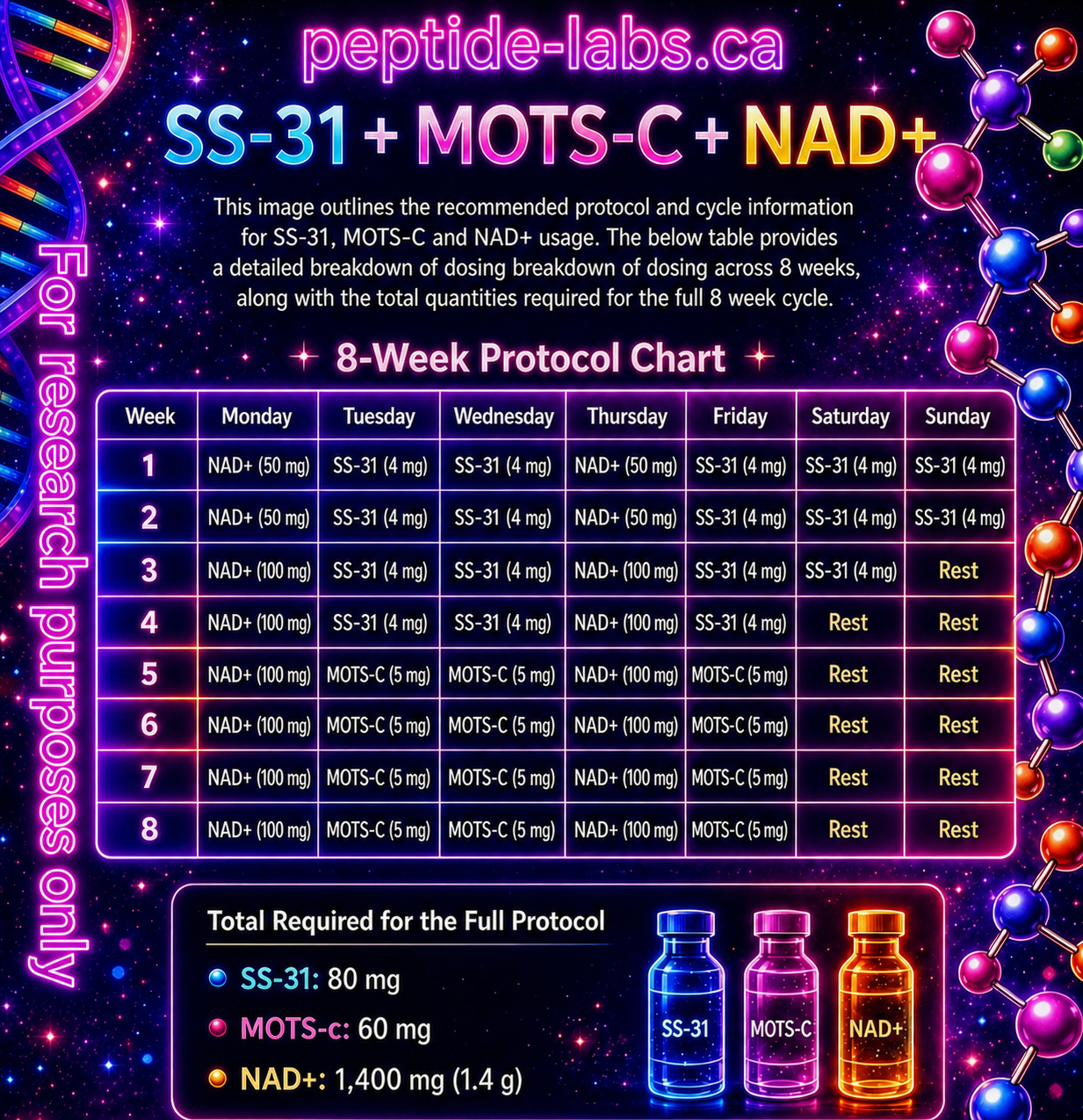
NAD+ is administered throughout the full 8 weeks, with dosing escalating from 50 mg to 100 mg at Week 3.
8-Week Dosing Schedule
For research purposes only. The chart above outlines the full 8-week dosing schedule with daily compound assignments and rest days.
Weekly Breakdown
Phase 1 — Weeks 1–4: SS-31 + NAD+
| Week | Monday | Tuesday | Wednesday | Thursday | Friday | Saturday | Sunday |
|---|---|---|---|---|---|---|---|
| 1 | NAD+ (50 mg) | SS-31 (4 mg) | SS-31 (4 mg) | NAD+ (50 mg) | SS-31 (4 mg) | SS-31 (4 mg) | SS-31 (4 mg) |
| 2 | NAD+ (50 mg) | SS-31 (4 mg) | SS-31 (4 mg) | NAD+ (50 mg) | SS-31 (4 mg) | SS-31 (4 mg) | SS-31 (4 mg) |
| 3 | NAD+ (100 mg) | SS-31 (4 mg) | SS-31 (4 mg) | NAD+ (100 mg) | SS-31 (4 mg) | SS-31 (4 mg) | Rest |
| 4 | NAD+ (100 mg) | SS-31 (4 mg) | SS-31 (4 mg) | NAD+ (100 mg) | SS-31 (4 mg) | Rest | Rest |
Phase 2 — Weeks 5–8: MOTS-C + NAD+
| Week | Monday | Tuesday | Wednesday | Thursday | Friday | Saturday | Sunday |
|---|---|---|---|---|---|---|---|
| 5 | NAD+ (100 mg) | MOTS-C (5 mg) | MOTS-C (5 mg) | NAD+ (100 mg) | MOTS-C (5 mg) | Rest | Rest |
| 6 | NAD+ (100 mg) | MOTS-C (5 mg) | MOTS-C (5 mg) | NAD+ (100 mg) | MOTS-C (5 mg) | Rest | Rest |
| 7 | NAD+ (100 mg) | MOTS-C (5 mg) | MOTS-C (5 mg) | NAD+ (100 mg) | MOTS-C (5 mg) | Rest | Rest |
| 8 | NAD+ (100 mg) | MOTS-C (5 mg) | MOTS-C (5 mg) | NAD+ (100 mg) | MOTS-C (5 mg) | Rest | Rest |
Total Quantities Required for the Full Protocol
| Compound | Total Required |
|---|---|
| SS-31 | 80 mg |
| MOTS-C | 60 mg |
| NAD+ | 1,400 mg (1.4 g) |
Mechanisms of Action
SS-31 (Szeto-Schiller Peptide)
SS-31 is a mitochondria-targeted tetrapeptide that selectively concentrates at the inner mitochondrial membrane (IMM), where it binds to cardiolipin — a phospholipid critical for electron transport chain (ETC) function. By stabilizing cardiolipin, SS-31 is researched for its ability to:
- Preserve mitochondrial cristae architecture
- Reduce reactive oxygen species (ROS) production at Complex I and III
- Restore ATP synthesis efficiency under oxidative stress conditions
- Attenuate mitochondrial permeability transition pore (mPTP) opening
Preclinical models have investigated SS-31 in contexts of ischemia-reperfusion injury, cardiac dysfunction, renal fibrosis, and age-related mitochondrial decline.
MOTS-C
MOTS-C (Mitochondrial Open Reading Frame of the 12S rRNA Type-C) is a mitochondrial-derived peptide encoded within the 12S rRNA gene of mitochondrial DNA. It translocates to the nucleus in response to metabolic stress, where it regulates nuclear gene expression related to:
- Glucose and lipid metabolism
- AMPK pathway activation
- Insulin sensitivity and glucose uptake in skeletal muscle
- Folate cycle and methionine metabolism (via AICAR accumulation)
Research in preclinical models has examined MOTS-C in the context of obesity, type 2 diabetes, exercise mimetics, and age-related metabolic decline.
NAD+ (Nicotinamide Adenine Dinucleotide)
NAD+ is a coenzyme central to cellular energy metabolism, serving as an electron carrier in glycolysis, the citric acid cycle, and oxidative phosphorylation. Beyond its metabolic role, NAD+ is a substrate for:
- Sirtuins (SIRT1–7): NAD+-dependent deacetylases involved in gene expression, DNA repair, and mitochondrial biogenesis
- PARP enzymes: DNA damage repair
- CD38/CD157: Calcium signalling and immune regulation
NAD+ levels decline with age and metabolic stress. Research has investigated NAD+ precursor supplementation and direct NAD+ administration for effects on mitochondrial function, cognitive performance, and metabolic health in preclinical and early clinical models.
Rationale for the Combination
The three-compound protocol is designed around complementary mechanisms:
-
SS-31 + NAD+ (Weeks 1–4): SS-31 stabilizes the mitochondrial membrane while NAD+ supports the electron transport chain and sirtuin activity. The combination is hypothesized to address both structural and functional aspects of mitochondrial decline simultaneously.
-
MOTS-C + NAD+ (Weeks 5–8): After establishing mitochondrial integrity in Phase 1, the protocol shifts to metabolic regulation. MOTS-C activates AMPK and improves glucose utilization; NAD+ continues to support sirtuin-mediated metabolic gene regulation. This phase targets downstream metabolic outcomes.
The phased approach avoids simultaneous administration of SS-31 and MOTS-C, allowing researchers to isolate phase-specific effects and reduce confounding variables.
Reconstitution Reference
All three compounds require reconstitution with bacteriostatic water (BAC water) prior to use. Refer to our General Peptide Reconstitution Guide for step-by-step instructions on sterile reconstitution technique, concentration calculations, and storage.
Suggested reconstitution concentrations:
- SS-31 10 mg vial: Reconstitute with 1 mL BAC water → 10 mg/mL (10,000 mcg/mL). Each 4 mg dose = 0.4 mL
- MOTS-C 10 mg vial: Reconstitute with 2 mL BAC water → 5 mg/mL (5,000 mcg/mL). Each 5 mg dose = 1.0 mL
- NAD+ 500 mg vial: Reconstitute with 5 mL BAC water → 100 mg/mL. 50 mg dose = 0.5 mL; 100 mg dose = 1.0 mL
Use our Reconstitution Calculator to verify volumes for your specific vial sizes.
Storage
| Compound | Lyophilized (Unreconstituted) | Reconstituted |
|---|---|---|
| SS-31 | −20°C, protected from light | 2–8°C, use within 28 days |
| MOTS-C | −20°C, protected from light | 2–8°C, use within 28 days |
| NAD+ | −20°C, protected from light | 2–8°C, use within 7 days (degrades faster in solution) |
Avoid repeated freeze-thaw cycles. Aliquot reconstituted solutions if long-term storage is required.
Research Use Only
All compounds listed in this protocol are intended solely for in vitro research and preclinical laboratory use. They are not approved for human consumption, veterinary use, or clinical application. This protocol is provided as a reference for qualified research professionals only.
Peptide-Labs supplies SS-31, MOTS-C, and NAD+ with independent third-party Certificate of Analysis (CoA) confirming ≥99% purity by HPLC. View our Certificate of Analysis page for current batch documentation.
Explore Topics
Written by
Peptide-Labs Research Team
Content creator and writer sharing insights and stories.