The Wolverine Stack: BPC-157 + TB-500 Research Guide
Why researchers combine BPC-157 and TB-500 in the Wolverine Stack, how each peptide works, who the research targets, and what makes this combination one of the most studied recovery-focused peptide pairings in Canada.
The Wolverine Stack: BPC-157 + TB-500 Research Guide
The Wolverine Stack is the combination of BPC-157 (Body Protection Compound) and TB-500 (Thymosin Beta-4 fragment) — two peptides that are consistently studied together in recovery and tissue repair research. While each has a distinct mechanism, they are frequently discussed as complementary compounds that target overlapping but different aspects of the repair process.
This guide covers what each peptide does, why researchers combine them, who the research typically focuses on, and what to know before working with the stack.
For educational and research reference only. These are research peptides — not FDA-approved treatments. Not for human or veterinary consumption.
What Is the Wolverine Stack?
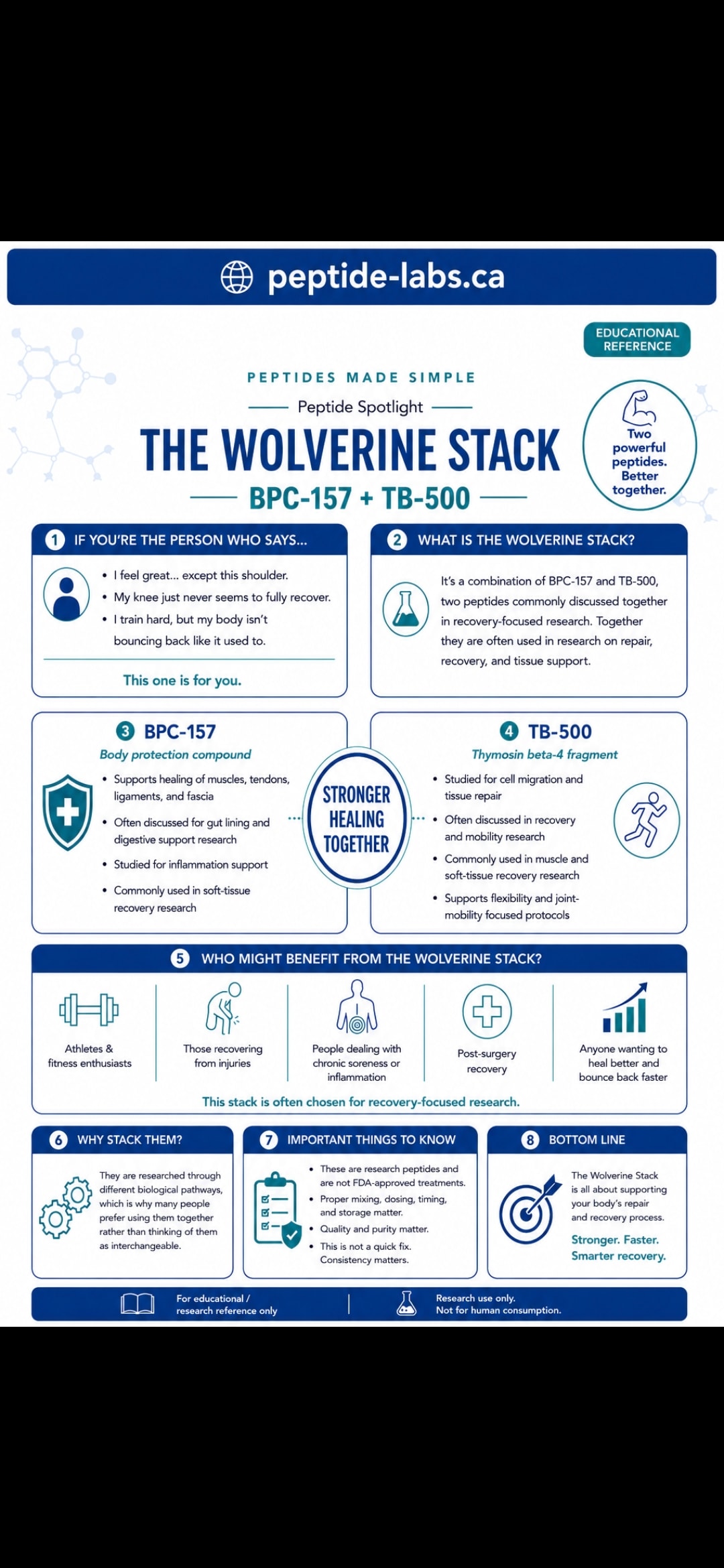
The Wolverine Stack is a combination of BPC-157 and TB-500, two peptides commonly discussed together in recovery-focused research. Together they are often used in studies on repair, recovery, and tissue support.
Peptide-Labs.ca offers the Wolverine Stack as a pre-blended vial — 10mg total (10mg BPC-157 + 10mg TB-500) — for researchers who prefer a single reconstitution rather than managing two separate vials.
BPC-157 — Body Protection Compound
BPC-157 is a synthetic pentadecapeptide derived from a protein found in gastric juice. It has been extensively studied for its role in tissue repair and regeneration.
Research areas:
- Supports healing of muscles, tendons, ligaments, and fascia
- Often discussed for gut lining and digestive support research
- Studied for inflammation support
- Commonly used in soft-tissue recovery research
Key characteristics:
- Mechanism: Upregulates growth factor receptors; promotes angiogenesis
- Half-life: ~4 hours (systemic); longer with local injection
- Stability: Stable in gastric juice; studied via both systemic and local administration
BPC-157 is one of the most referenced peptides in soft-tissue and connective tissue repair literature. Its ability to promote angiogenesis (new blood vessel formation) is considered central to its tissue-healing properties.
TB-500 — Thymosin Beta-4 Fragment
TB-500 is a synthetic fragment of Thymosin Beta-4, a naturally occurring protein involved in actin regulation and cell migration. It is studied primarily for its role in tissue repair and mobility.
Research areas:
- Studied for cell migration and tissue repair
- Often discussed in recovery and mobility research
- Commonly used in muscle and soft-tissue recovery research
- Supports flexibility and joint-mobility focused protocols
Key characteristics:
- Mechanism: Binds actin; promotes cell migration and differentiation
- Half-life: ~2–3 days
- Effect: Systemic distribution; studied for both local and remote tissue effects
TB-500's ability to upregulate actin — a protein critical to cell structure and movement — is what makes it particularly relevant in research on wound healing, muscle repair, and joint mobility.
Why Researchers Combine BPC-157 and TB-500
BPC-157 and TB-500 are researched through different biological pathways, which is why many researchers prefer using them together rather than thinking of them as interchangeable.
| BPC-157 | TB-500 | |
|---|---|---|
| Primary mechanism | Angiogenesis, growth factor upregulation | Actin binding, cell migration |
| Primary focus | Soft tissue, gut, tendons, ligaments | Muscle, connective tissue, mobility |
| Half-life | ~4 hours | ~2–3 days |
| Administration | Local or systemic | Systemic |
Together, the two peptides address complementary aspects of the repair process:
- BPC-157 promotes the vascular and structural groundwork for tissue repair — new blood vessels, growth factor signalling, and connective tissue support
- TB-500 drives the cellular migration and actin-based remodelling that follows — helping cells move to the repair site and reorganize tissue structure
The combination is described in research as producing a more comprehensive repair response than either peptide studied in isolation.
Who Does the Research Focus On?
Based on published research and common protocol design, the Wolverine Stack is most frequently studied in the context of:
- Athletes and fitness enthusiasts — recovery from training stress and overuse
- Those recovering from injuries — acute soft-tissue damage, sprains, strains
- People dealing with chronic soreness or inflammation — persistent joint or muscle issues
- Post-surgery recovery — tissue repair following surgical intervention
- Anyone wanting to heal better and bounce back faster — general recovery optimization
This stack is often chosen for recovery-focused research.
Important Things to Know
Before working with the Wolverine Stack, researchers should be aware of the following:
- These are research peptides and are not FDA-approved treatments
- Proper mixing, dosing, timing, and storage matter — reconstitution protocol affects peptide stability and concentration accuracy
- Quality and purity matter — always source from a supplier with published third-party COAs
- This is not a quick fix — consistency in research protocols matters for meaningful data
Reconstituting the Wolverine Stack
The Wolverine Stack 20mg vial (10mg BPC-157 + 10mg TB-500) follows standard peptide reconstitution protocol.
Recommended reconstitution:
- Add 2mL bacteriostatic water to the 20mg blend vial
- Final concentration: 10,000 mcg/mL (10 mg/mL) total peptide
Inject BAC water slowly against the glass wall of the vial. Swirl gently — do not shake. The solution should become clear within a few minutes.
Use the Peptide-Labs.ca Reconstitution Calculator to calculate draw volumes for any dose target.
Dosing Calculations
With 2mL BAC water in a 20mg vial (10,000 mcg/mL total):
| Dose (total) | Draw Volume | Units (100-unit syringe) |
|---|---|---|
| 250 mcg | 0.025 mL | 2.5 units |
| 500 mcg | 0.05 mL | 5 units |
| 1,000 mcg | 0.10 mL | 10 units |
| 2,000 mcg | 0.20 mL | 20 units |
Each dose contains equal parts BPC-157 and TB-500 at the fixed 1:1 ratio in the blend vial.
Storage Guidelines
- Lyophilized powder: Store at -20°C; stable for 24 months
- Reconstituted solution: Refrigerate at 2–8°C; use within 4–6 weeks
- Protect from light; do not freeze reconstituted peptide
The Bottom Line
The Wolverine Stack is all about supporting the body's repair and recovery process through two complementary peptide mechanisms. BPC-157 handles the vascular and structural side; TB-500 handles cell migration and tissue remodelling. Together, they represent one of the most studied recovery-focused peptide combinations in current research literature.
Stronger. Faster. Smarter recovery.
Source the Wolverine Stack in Canada
Peptide-Labs.ca ships the Wolverine Stack across Canada. The blend vial is third-party tested — view current batch documentation on the COA page.
- Wolverine Stack 20mg — $88.00 CAD
- BAC Water 3mL — required for reconstitution
- BAC Water 10mL — for multiple vials
We ship to researchers across Canada including Edmonton, Alberta, and all provinces. See our Canadian peptide shipping guide for delivery details.
Related Research Guides
- How to Reconstitute BPC-157 — step-by-step reconstitution walkthrough
- How to Buy Research Peptides in Canada — what to look for in a Canadian peptide supplier
- Peptide Reconstitution General Guide — applies to all peptides including the Wolverine Stack
All products sold by Peptide-Labs.ca are intended exclusively for in vitro research and laboratory use. Not for human or veterinary use.
Explore Topics
Written by
Peptide-Labs Research Team
Content creator and writer sharing insights and stories.