5-Amino-1MQ Research Guide: NNMT Inhibition and Metabolic Research
A complete research reference for 5-Amino-1MQ — covering its NNMT inhibitor mechanism, NAD+ pathway modulation, adipogenesis inhibition, metabolic research applications, and dosing for Canadian researchers.
5-Amino-1MQ Research Guide: NNMT Inhibition and Metabolic Research
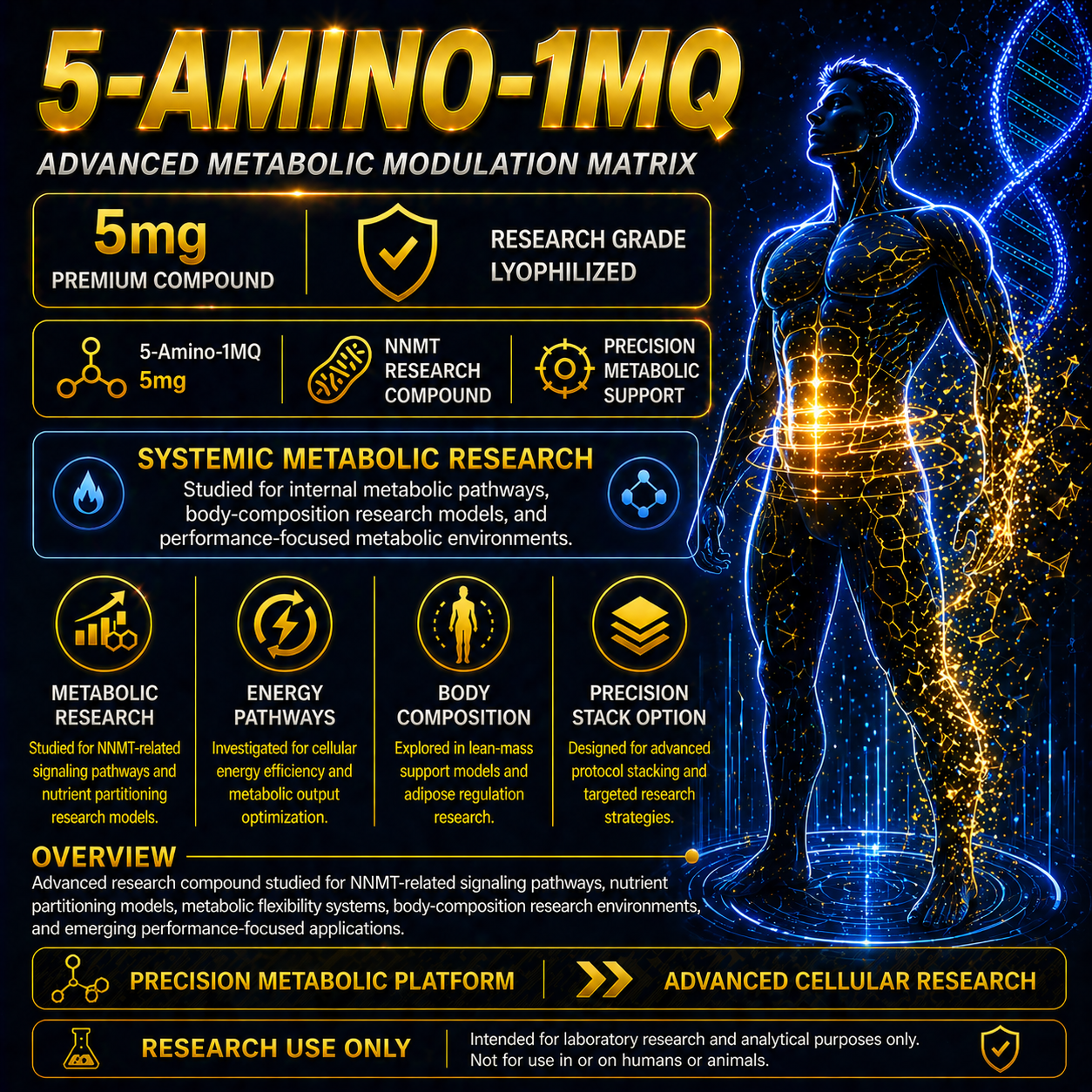
5-Amino-1-methylquinolinium (5-Amino-1MQ) is a small molecule inhibitor of nicotinamide N-methyltransferase (NNMT), an enzyme that plays a central role in NAD+ metabolism, adipogenesis, and metabolic regulation. Unlike peptide-based research compounds, 5-Amino-1MQ is a quinolinium salt — a small organic molecule — making it unique in the Peptide-Labs catalog. Its research profile has attracted significant interest in the context of obesity, metabolic syndrome, and NAD+ biology.
What Is 5-Amino-1MQ?
5-Amino-1MQ is a competitive inhibitor of NNMT (nicotinamide N-methyltransferase), an enzyme that catalyzes the methylation of nicotinamide (a form of vitamin B3) using S-adenosylmethionine (SAM) as the methyl donor, producing 1-methylnicotinamide (1-MNA) and S-adenosylhomocysteine (SAH).
Molecular characteristics:
- Full name: 5-Amino-1-methylquinolinium
- Molecular weight: 174.2 Da (free base) / ~210 Da (salt form)
- CAS number: 1380424-42-9
- Class: Quinolinium salt / NNMT inhibitor
- Mechanism: Competitive inhibitor of NNMT
The NNMT Pathway: Why It Matters
To understand 5-Amino-1MQ, it is essential to understand NNMT's role in cellular metabolism:
NNMT and NAD+ Metabolism
NNMT consumes nicotinamide — a precursor to NAD+ — by methylating it to 1-MNA. This effectively diverts nicotinamide away from the NAD+ biosynthesis pathway. By inhibiting NNMT, 5-Amino-1MQ:
- Increases intracellular nicotinamide availability
- Drives nicotinamide into the NAD+ salvage pathway (via NAMPT)
- Elevates intracellular NAD+ levels
This makes 5-Amino-1MQ a NAD+ booster via an indirect mechanism — distinct from direct NAD+ precursors like NMN or NR.
NNMT and the Methyl Economy
NNMT is one of the largest consumers of SAM (S-adenosylmethionine) in adipose tissue. By inhibiting NNMT, 5-Amino-1MQ:
- Reduces SAM consumption
- Increases SAM availability for other methylation reactions
- Affects the methionine cycle and one-carbon metabolism
This has downstream effects on DNA methylation, histone methylation, and gene expression regulation.
NNMT Overexpression in Obesity and Cancer
NNMT is overexpressed in adipose tissue in obesity and in multiple cancer types. This overexpression is associated with:
- Increased adipogenesis and fat cell differentiation
- Reduced energy expenditure in adipocytes
- Altered NAD+ metabolism
- Pro-tumorigenic metabolic reprogramming
NNMT inhibition with 5-Amino-1MQ is therefore studied as a potential intervention in both metabolic disease and cancer metabolism research.
Mechanism of Action
Adipogenesis Inhibition
The most studied effect of 5-Amino-1MQ in preclinical models is inhibition of adipogenesis — the differentiation of preadipocytes into mature fat cells. Research has demonstrated that NNMT inhibition:
- Reduces expression of adipogenic transcription factors (PPARγ, C/EBPα)
- Decreases lipid accumulation in differentiating adipocytes
- Reduces adipocyte size in mature fat cells
- Increases lipolysis markers
NAD+ Elevation and Sirtuin Activation
By increasing intracellular NAD+, 5-Amino-1MQ activates NAD+-dependent sirtuins (particularly SIRT1 and SIRT3), which regulate:
- Mitochondrial biogenesis (via PGC-1α deacetylation)
- Fatty acid oxidation
- Glucose metabolism
- Cellular stress resistance
Energy Expenditure
Preclinical studies in diet-induced obese mice have demonstrated that 5-Amino-1MQ treatment increases energy expenditure without reducing food intake — a metabolically favourable profile for obesity research.
Insulin Sensitivity
Research has examined 5-Amino-1MQ's effects on insulin signalling in adipose tissue and skeletal muscle, with evidence of improved insulin sensitivity in preclinical obesity models.
Research Applications
Obesity and Adipose Biology
5-Amino-1MQ is primarily studied as a tool for investigating NNMT's role in adipose tissue biology and obesity. Preclinical studies in diet-induced obese mice have demonstrated:
- Reduced body weight gain
- Decreased fat mass
- Improved metabolic parameters (glucose tolerance, insulin sensitivity)
- Increased energy expenditure
NAD+ Biology
5-Amino-1MQ provides a unique approach to studying NAD+ biology — elevating NAD+ via NNMT inhibition rather than direct precursor supplementation. This allows researchers to dissect the specific contribution of the NNMT-NAD+ axis to metabolic outcomes.
Cancer Metabolism
NNMT is overexpressed in multiple cancers (ovarian, bladder, gastric, thyroid). 5-Amino-1MQ has been studied in cancer cell lines for its effects on metabolic reprogramming, proliferation, and sensitivity to chemotherapy.
Methyl Metabolism Research
5-Amino-1MQ's effects on SAM availability make it a research tool for studying one-carbon metabolism, DNA methylation dynamics, and epigenetic regulation.
Combination with NAD+ Precursors
5-Amino-1MQ is sometimes studied in combination with NAD+ precursors (NMN, NR) or direct NAD+ to examine additive or synergistic effects on cellular NAD+ levels and downstream metabolic outcomes. See our SS-31 + MOTS-C + NAD+ Protocol for an example of NAD+ combination research design.
Reconstitution and Preparation
Unlike peptides, 5-Amino-1MQ is a small molecule that may be prepared differently depending on the research application:
Aqueous solution (for in vivo research):
- Dissolve in sterile saline or PBS at the desired concentration
- 5-Amino-1MQ is water-soluble as a salt form
- Typical working concentration: 1–10 mg/mL
DMSO stock (for cell culture):
- Prepare a 10–100 mM stock in DMSO
- Dilute to working concentration in cell culture medium
- Final DMSO concentration should not exceed 0.1% in cell culture
Dosing Reference (Preclinical Models)
| Model | Dose | Route | Duration |
|---|---|---|---|
| Diet-induced obesity (mouse) | 40–80 mg/kg/day | Oral / SC | 4–12 weeks |
| Adipogenesis (cell culture) | 1–100 µM | In vitro | Duration of differentiation |
| NAD+ elevation | 40 mg/kg/day | SC | 2–4 weeks |
| Cancer cell lines | 1–50 µM | In vitro | 24–72 hours |
Storage
| State | Conditions | Duration |
|---|---|---|
| Powder | Room temperature or −20°C, dry, protected from light | 24+ months |
| Aqueous solution | 2–8°C, protected from light | Up to 14 days |
| DMSO stock | −20°C, protected from light | Up to 6 months |
5-Amino-1MQ is more stable than most peptides. Nonetheless, protect from moisture and light.
Availability at Peptide-Labs
5-Amino-1MQ 50 mg is currently coming soon at Peptide-Labs. We are completing quality verification and third-party CoA testing before release. Join the waitlist to be notified when 5-Amino-1MQ becomes available.
Research Use Only
5-Amino-1MQ is intended solely for in vitro research and preclinical laboratory use. It is not approved for human consumption, veterinary use, or clinical application in Canada. All research must be conducted by qualified professionals in compliance with applicable regulations.
Explore Topics
Written by
Peptide-Labs Research Team
Content creator and writer sharing insights and stories.